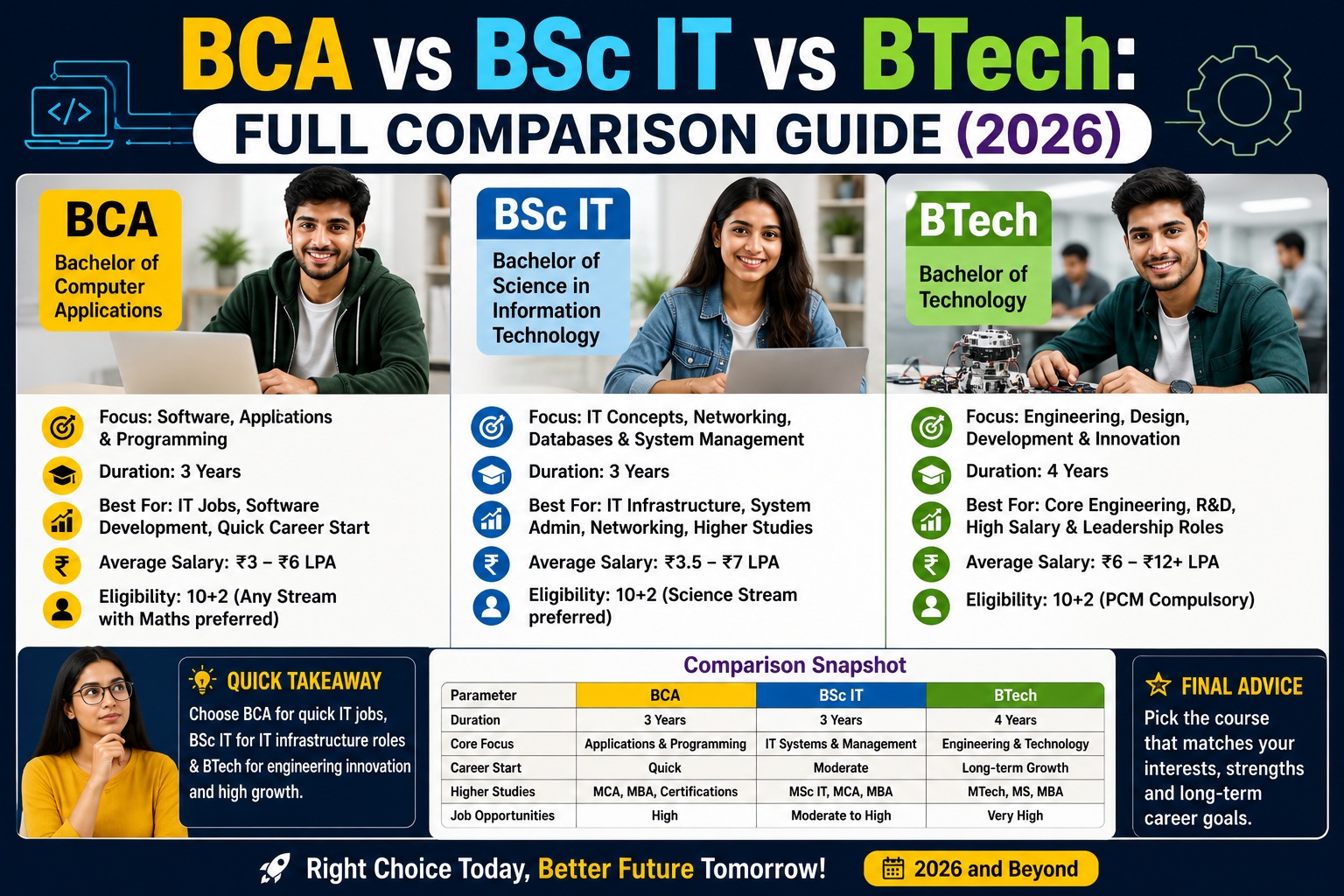
BCA vs BSc IT vs BTech: Full Comparison Guide (2026)
BCA vs BSc IT vs BTech: Which Is Best in 2026?
Choosing the right course after Class 12 is one of the biggest decisions in a student’s life.
Some students are told, “Take BTech, it has the most value.” Others hear that BCA is cheaper and easier. Some believe BSc IT is the safer middle option.
The result? Confusion, pressure, and fear of making the wrong decision.
If you are wondering:
- Which is better: BCA, BSc IT, or BTech?
- Which course has better salary and placement?
- Which course is best if you are weak in PCM?
- Which course gives the best return on investment?
Then this guide is for you.
This is not a biased article. As career counselors and education experts, we will compare all three courses honestly—based on subjects, difficulty, cost, salary, placements, and future scope in India.
Quick Comparison Summary
|
Factor |
BCA |
BSc IT |
BTech |
|
Full Form |
Bachelor of Computer Applications |
Bachelor of Science in Information Technology |
Bachelor of Technology |
|
Duration |
3 Years |
3 Years |
4 Years |
|
Best For |
Students interested in software and IT |
Students who want a balanced technical degree |
Students interested in engineering and deeper technical learning |
|
PCM Required? |
Usually No |
Sometimes No |
Yes in most colleges |
|
Coding Level |
Moderate to High |
Moderate |
High |
|
Course Cost |
Low to Medium |
Low to Medium |
High |
|
Average Starting Salary |
₹2.5–5 LPA |
₹2–4.5 LPA |
₹4–10 LPA |
|
Difficulty Level |
Moderate |
Moderate |
High |
|
Higher Study Options |
MCA, MBA, MSc IT |
MSc IT, MCA, MBA |
MTech, MBA, MS |
|
Best for a Quick Job? |
Yes |
Yes |
Not always |
|
Best Long-Term Growth? |
Good |
Moderate |
Excellent |
Quick Answer
If you want the best engineering value and can afford higher fees, BTech is usually the strongest option.
If you want a practical IT career without PCM pressure or high cost, BCA is often the better choice.
If you want a simple, theory-based technology degree with lower pressure, BSc IT can be suitable.
What is BCA?
BCA (Bachelor of Computer Applications) is a 3-year undergraduate degree focused on computer applications, software development, programming, databases, and IT.
It is designed for students who want to build a career in the IT industry without taking an engineering degree.
Main Subjects in BCA
- Programming Languages (C, Java, Python)
- Database Management
- Web Development
- Computer Networks
- Software Engineering
- Cloud Computing
- Data Structures
Who Should Choose BCA?
- Students interested in computers and coding
- Students from Commerce or Arts who want to enter IT
- Students who want lower fees than BTech
- Students weak in Physics, Chemistry, and Maths
What is BSc IT?
BSc IT (Bachelor of Science in Information Technology) is a 3-year degree that combines IT concepts with science-based theoretical learning.
Compared to BCA, BSc IT is often more theory-focused and slightly less practical.
Main Subjects in BSc IT
- Information Technology
- Networking
- Database Systems
- Operating Systems
- Mathematics
- Cyber Security
- Statistics
Who Should Choose BSc IT?
- Students who enjoy technical subjects but not intense coding
- Students interested in IT support, networking, or system administration
- Students who want a simpler technical degree
What is BTech?
BTech (Bachelor of Technology) is a 4-year engineering degree. Students usually choose branches such as:
- Computer Science Engineering
- Information Technology
- Artificial Intelligence
- Electronics
- Data Science
BTech goes deeper into programming, mathematics, algorithms, hardware, and engineering concepts.
Main Subjects in BTech
- Data Structures and Algorithms
- Computer Architecture
- Operating Systems
- Artificial Intelligence
- Machine Learning
- Engineering Mathematics
- Software Development
Who Should Choose BTech?
- Students who are strong in PCM
- Students who want engineering-level technical depth
- Students targeting high-paying tech jobs or MNCs
Detailed Comparison: BCA vs BSc IT vs BTech
1. Subjects and Curriculum Depth
|
Factor |
BCA |
BSc IT |
BTech |
|
Focus |
Software applications |
IT concepts and systems |
Engineering + advanced tech |
|
Practical Learning |
High |
Moderate |
High |
|
Mathematics Level |
Basic to Moderate |
Moderate |
High |
|
Coding Depth |
Good |
Moderate |
Advanced |
|
Industry Projects |
Yes |
Limited |
Extensive |
Key Difference
- BCA focuses on software and practical IT skills
- BSc IT focuses on general IT knowledge
- BTech focuses on engineering-level problem-solving and deep technical skills
2. Skills Required
BCA Requires:
- Logical thinking
- Interest in coding
- Creativity
- Problem-solving
BSc IT Requires:
- Analytical thinking
- Patience for theory
- Basic technical interest
BTech Requires:
- Strong PCM foundation
- High problem-solving ability
- Discipline and consistency
- Ability to handle difficult subjects
3. Coding Requirement Level
Quick Answer
BTech requires the most coding, BCA requires moderate coding, and BSc IT usually requires the least.
|
Course |
Coding Level |
|
BCA |
Moderate to High |
|
BSc IT |
Moderate |
|
BTech |
High |
If you do not enjoy coding at all, none of these courses may be ideal. But if you like technology without heavy programming, BSc IT may feel easier.
4. Career Opportunities
|
Course |
Common Career Options |
|
BCA |
Software Developer, Web Developer, App Developer, IT Support, Data Analyst |
|
BSc IT |
Network Administrator, System Analyst, IT Support, Cyber Security Assistant |
|
BTech |
Software Engineer, AI Engineer, Data Scientist, Cloud Engineer, Product Developer |
Placement Trend in India (2026)
- BTech graduates from strong colleges still get the highest placements.
- BCA students with coding skills and internships are now getting good opportunities.
- BSc IT graduates often need additional certifications or higher studies.
The reality is that companies today hire based more on skills than degree.
A BCA student with strong coding skills can sometimes earn more than an average BTech student.
5. Salary Expectations in India
|
Course |
Fresher Salary |
After 5 Years |
|
BCA |
₹2.5–5 LPA |
₹6–12 LPA |
|
BSc IT |
₹2–4.5 LPA |
₹5–8 LPA |
|
BTech |
₹4–10 LPA |
₹10–20+ LPA |
BCA vs BTech Salary in India
BTech generally offers higher starting salaries because companies view it as a stronger engineering qualification.
However, BCA students who learn:
- Full-stack development
- Python
- Data Analytics
- Cloud Computing
- AI tools
can quickly close the gap.
Reality Check
A private college BTech student without skills may earn less than a BCA student with strong projects and internships.
6. Cost and ROI
One of the biggest mistakes students make is looking only at salary—not at how much money and time they invest.
|
Course |
Average Fees in India |
Duration |
ROI |
|
BCA |
₹1–3 Lakhs |
3 Years |
High |
|
BSc IT |
₹80,000–2.5 Lakhs |
3 Years |
Moderate |
|
BTech |
₹4–15 Lakhs |
4 Years |
Depends on college |
Which Course Gives Better ROI?
- If you are from a Tier 2 or Tier 3 city and want a lower-cost option, BCA often gives the best return on investment.
- BTech gives excellent ROI only if you study from a good college and build strong skills.
- BSc IT is affordable, but salary growth may be slower.
7. Difficulty Level
|
Course |
Difficulty |
|
BCA |
Moderate |
|
BSc IT |
Moderate |
|
BTech |
High |
BTech is more difficult because it includes advanced mathematics, engineering subjects, and deeper technical concepts.
BCA is easier than BTech but still requires coding and practice.
BSc IT is usually the easiest among the three.
8. Future Scope in 2026 and Beyond
BCA Scope
- Growing demand in software, web development, and digital services
- Strong opportunities in startups and small companies
- Excellent if combined with MCA or certifications
BSc IT Scope
- Good for support and system roles
- Better if combined with certifications like Cyber Security or Networking
BTech Scope
- Best for high-end tech roles
- Strong demand in AI, Data Science, Robotics, Cloud Computing
Future Technologies Creating Demand
- Artificial Intelligence
- Data Analytics
- Cyber Security
- Cloud Computing
- App Development
Students from any of these courses can enter these fields if they build the right skills.
Pros and Cons
BCA Pros and Cons
Pros
- Lower fees
- No strict PCM requirement
- Good for IT careers
- Easier entry into software industry
- Strong ROI
Cons
- Lower brand value than BTech
- Needs extra certifications or MCA for faster growth
- Heavy competition
BSc IT Pros and Cons
Pros
- Affordable
- Less pressure than BTech
- Good for networking and support jobs
Cons
- Lower placement opportunities
- More theoretical
- Less value in top tech companies
BTech Pros and Cons
Pros
- Highest value in job market
- Better placement opportunities
- Strong long-term growth
- Best for MNCs and advanced tech jobs
Cons
- Expensive
- Requires strong PCM background
- More difficult and stressful
Best Course Based on Student Type
For Budget-Conscious Students
Choose BCA.
Why?
- Lower fees
- Faster entry into jobs
- Good return on investment
For Students Weak in PCM
Choose BCA or BSc IT.
Avoid BTech if you struggle heavily with Physics and Maths.
For Students Who Love Coding
Choose BTech or BCA.
- BTech if you want deeper technical learning
- BCA if you want practical coding without engineering pressure
For Students Who Want Quick Jobs
Choose BCA.
A 3-year degree plus certifications can help you start working earlier.
For Students Thinking Long-Term
Choose BTech.
It usually offers stronger growth over 10–15 years.
Career Paths After Each Course
After BCA
- Software Developer
- Web Developer
- App Developer
- UI/UX Designer
- Data Analyst
- MCA
After BSc IT
- System Administrator
- Technical Support Engineer
- Network Administrator
- Cyber Security Analyst
- MSc IT
After BTech
- Software Engineer
- Data Scientist
- AI Engineer
- Cloud Engineer
- Product Manager
- MTech or MS
Reality Check: Expectations vs Reality
|
Myth |
Reality |
|
BTech guarantees a high salary |
Only if you have skills and a good college |
|
BCA has no value |
BCA has strong value with coding and certifications |
|
BSc IT is useless |
It can work well for networking and support roles |
|
Degree alone is enough |
Skills, internships, and projects matter more |
The Biggest Skill Gap in India
Most students focus only on getting a degree.
But companies in 2026 want:
- Coding skills
- Communication skills
- Projects
- Internships
- Problem-solving ability
This is why many students remain unemployed even after completing a good course.
Which Course Should You Choose?
Use this simple decision framework:
Choose BCA if:
- You want an affordable IT degree
- You do not have PCM
- You want to enter the software industry quickly
- You enjoy practical learning
Choose BSc IT if:
- You want a simpler IT course
- You prefer less coding
- You want lower academic pressure
Choose BTech if:
- You are strong in PCM
- You can afford higher fees
- You want the best long-term technical career
Biggest Mistakes Students Make While Choosing These Courses
- Choosing based on friends
- Choosing only because “BTech has more respect”
- Ignoring course cost and ROI
- Underestimating coding requirements
- Not checking placement quality of the college
- Choosing a course without knowing their strengths
- Thinking degree alone guarantees success
Frequently Asked Questions
Which is better: BCA or BTech or BSc IT?
BTech is better for long-term engineering careers, BCA is better for affordable IT careers, and BSc IT is better for students wanting a simpler technical degree.
Is BCA equal to BTech?
No. BTech is an engineering degree and usually has higher market value. However, skilled BCA graduates can still get excellent jobs.
Which course has the highest salary?
BTech generally offers the highest salary, especially from good colleges.
Can Commerce students do BCA?
Yes. Many colleges allow Commerce students to take BCA.
Is BSc IT better than BCA?
BCA is usually considered better for software and coding careers, while BSc IT is better for networking and support roles.
Which is the best IT course after 12th?
There is no single best course. The best choice depends on your interest, budget, academic background, and career goal.
Conclusion
There is no “perfect” course for everyone.
- Choose BCA if you want affordability, practical learning, and quicker entry into the IT industry.
- Choose BSc IT if you want a simpler and less expensive technical degree.
- Choose BTech if you want the strongest technical foundation and can handle the cost and difficulty.
At UBM College, students receive more than just a degree. They receive:
- Practical IT-focused learning
- Career counseling
- Skill development support
- Placement guidance
Whether you choose BCA, BSc IT, or another career path, the most important thing is to choose a course that matches your strengths—not just what others are doing.
If you are still confused, talk to the academic counselors at UBM College and get personal guidance before making your final decision.