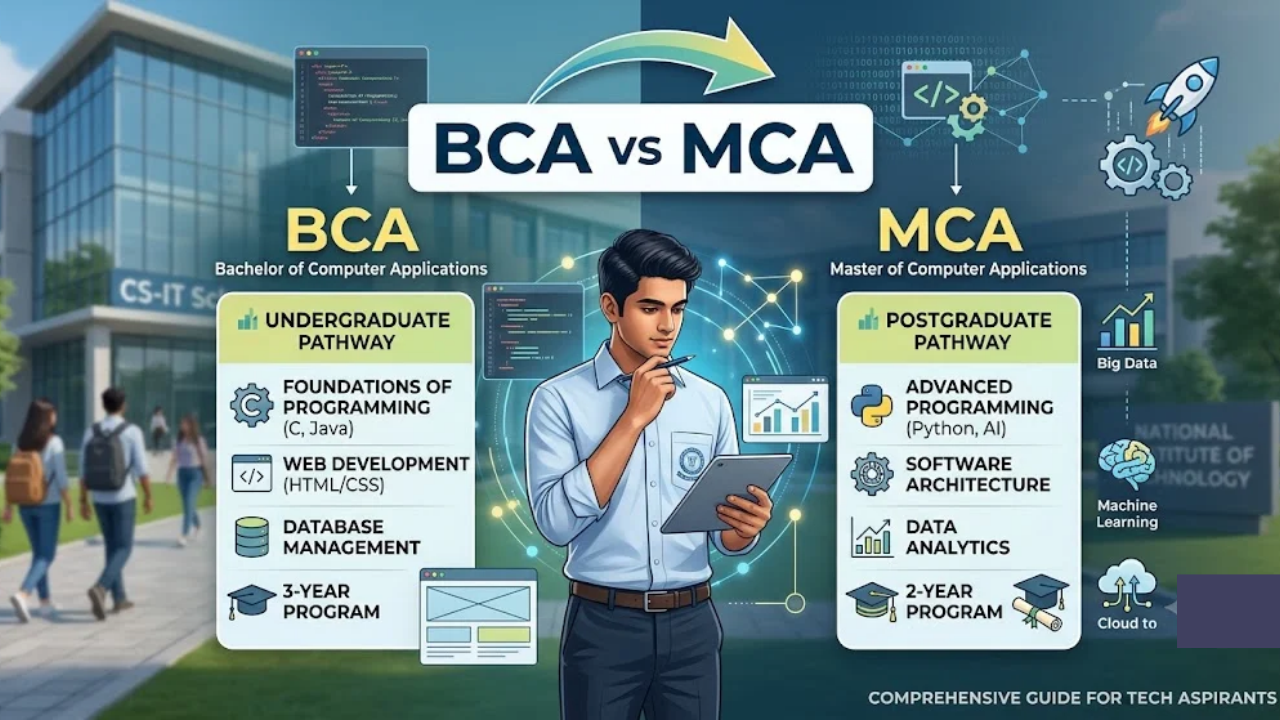
BCA vs MCA: Difference, Career & Higher Study Options
BCA vs MCA: Difference, Career Opportunities & Higher Study Options
Meta Title: BCA vs MCA: Difference, Career & Higher Study Options
Meta Description: Compare BCA vs MCA, including course duration, eligibility, career opportunities, skills, higher studies and how to choose the right path.
Slug: bca-vs-mca
BCA vs MCA: Which Path Is Right for Your Career?
Choosing between BCA and MCA can be an important decision for students planning a career in information technology and computer applications. While BCA is generally an undergraduate degree, MCA is a postgraduate programme that can be pursued after completing a relevant bachelor's degree.
Students often ask: Should I do BCA or MCA? Is MCA necessary after BCA? What are the career opportunities after BCA and MCA? The answer depends on your academic background, career goals, technical interests and plans for higher education.
What Is BCA?
BCA (Bachelor of Computer Applications) is an undergraduate degree designed for students interested in computer applications, software and information technology.
During BCA, students typically develop a foundation in areas such as programming, databases, web technologies, computer fundamentals and software development.
Students can also explore different BCA specializations and build practical skills based on their career interests.
Who Can Consider BCA?
BCA can be considered by students who:
- Have completed Class 12 or an equivalent qualification
- Are interested in computers and technology
- Want to build programming and application-development skills
- Plan to enter the IT sector after graduation
- Want to pursue higher studies such as MCA later
The exact eligibility requirements can vary by institution, so students should check the admission requirements of the college they plan to join.
What Is MCA?
MCA (Master of Computer Applications) is a postgraduate programme that allows students to pursue advanced study in computer applications and related areas.
An MCA can help students deepen their understanding of areas such as software development, programming, databases, computer systems and emerging technology domains, depending on the curriculum of the institution.
For BCA graduates, MCA is one possible higher study option after BCA.
However, pursuing MCA is not the only pathway. A student's choice should depend on their career objectives, academic interests and the skills they want to develop.
BCA vs MCA: Key Differences
The main difference is that BCA is an undergraduate programme, while MCA is a postgraduate programme.
|
Factor |
BCA |
MCA |
|
Level |
Undergraduate |
Postgraduate |
|
Full Form |
Bachelor of Computer Applications |
Master of Computer Applications |
|
Main Purpose |
Build foundational knowledge |
Develop advanced knowledge |
|
Entry Point |
Usually after Class 12 |
After a relevant bachelor's degree, subject to eligibility |
|
Focus |
Computer applications and fundamentals |
Advanced computer applications and technical areas |
|
Career Stage |
Entry-level opportunities |
Opportunities requiring or valuing postgraduate education |
|
Higher Studies |
MCA and other relevant programmes |
Further specialised study/certifications, depending on goals |
Because programmes and eligibility rules can differ between institutions, students should verify the current requirements before applying.
BCA vs MCA: Difference in Career Opportunities
BCA and MCA can lead to different stages of a technology career.
After BCA, graduates may explore entry-level roles such as:
- Junior Software Developer
- Web Developer
- Technical Support Executive
- Software Support Associate
- Junior Data or IT-related roles
- Application Support roles
The actual opportunities available depend on a candidate's skills, projects, internships, communication ability and employer requirements.
After MCA, graduates may be able to apply for roles that require or prefer postgraduate-level education, depending on the employer.
Possible career areas include:
- Software Development
- Web and Application Development
- Database Management
- Systems and IT Support
- Data-related roles
- Software Testing
- Cybersecurity-related roles
- IT Consulting and Technology Services
Rather than relying only on the degree title, students should also focus on developing job-relevant technical and professional skills.
Is MCA Necessary After BCA?
No, MCA is not automatically necessary after BCA.
A BCA graduate can choose to start working, develop industry skills or pursue further education. For example, one student may prefer to enter the workforce after BCA and gain practical experience. Another may choose MCA to continue formal education and develop more advanced knowledge.
The decision can depend on:
- Desired job role
- Technical interests
- Academic goals
- Financial considerations
- Interest in postgraduate education
- Current skills and experience
- Employer requirements for the target role
Students should research the requirements of the careers they are interested in before deciding whether MCA is the right next step.
Career Opportunities After BCA
BCA provides a foundation that students can build upon through technical skills, projects and internships.
1. Software Development
Students interested in coding can work toward software development roles by strengthening programming languages, problem-solving and software development practices.
2. Web Development
Web development can be an option for students who enjoy creating websites and web applications. Learning front-end and back-end technologies can help students develop a practical portfolio.
3. Data and Analytics
Students interested in data can explore data analytics after BCA by learning areas such as spreadsheets, databases, SQL, statistics and data-visualisation tools.
4. Cybersecurity
Cybersecurity is another technology area that students can explore. Those interested in cybersecurity after BCA can begin by understanding networking, operating systems, security fundamentals and relevant tools.
5. IT Support and Application Services
BCA graduates can also explore IT support, application support and related technology-service roles where troubleshooting and technical communication are important.
Career Opportunities After MCA
MCA can provide a pathway toward more advanced study in computer applications and technology.
Depending on their skills and the requirements of employers, MCA graduates may explore areas such as:
- Software engineering
- Full-stack development
- Application development
- Database administration
- Systems and IT services
- Data and analytics
- Cybersecurity
- Cloud and technology services
- Software testing and quality assurance
The degree itself does not guarantee a particular job or salary. Practical skills, experience, projects, internships and employer requirements also influence career opportunities.
BCA vs MCA: Which One Has Better Career Scope?
Instead of asking which degree has “better” scope, it is more useful to consider which stage of education matches your current situation and career goal.
Choose BCA if you:
- Are completing Class 12 and want to enter the field of computer applications
- Want to build a foundation in IT
- Want the option to work after graduation
- May consider MCA or another higher-study programme later
Consider MCA if you:
- Already have a relevant bachelor's degree
- Want postgraduate-level education in computer applications
- Want to deepen your technical knowledge
- Are interested in career paths where postgraduate education may be useful or preferred
For many students, BCA and MCA are not competing choices. They can be two stages of the same academic pathway.
Skills to Learn During BCA Before MCA or Employment
Regardless of whether you plan to pursue MCA, developing practical skills during BCA can be valuable.
Students can focus on:
- Programming fundamentals
- Data structures and problem-solving
- Database and SQL skills
- Web development
- Git and version control
- Basic cybersecurity concepts
- Data analytics fundamentals
- Communication skills
- Presentation skills
- Project development
Students should also build projects that demonstrate what they can actually create or solve. For example, a student interested in web development could create a small website or web application, while someone interested in data could work on a basic data-analysis project.
BCA to MCA: A Possible Academic Pathway
A common academic pathway can look like this:
Class 12 → BCA → MCA → Specialised Skills/Certifications → Technology Career
However, this is only one possible route.
Another pathway could be:
Class 12 → BCA → Internship/Job → Professional Experience → Further Education
Students can also explore specialised certifications or other postgraduate programmes based on their interests. The right pathway depends on individual goals rather than following the same route as everyone else.
BCA vs MCA: What Should Students Consider Before Choosing?
Before selecting a course or deciding whether to pursue MCA, consider these questions:
What Kind of Work Interests You?
If you enjoy programming, software, websites, data or technology systems, computer-related education may align with your interests.
Do You Want to Start Working Early?
Students who want to explore employment after graduation may choose to build strong practical skills during BCA and look for internships or entry-level opportunities.
Do You Prefer Higher Education?
If you enjoy academic learning and want postgraduate education, MCA may be worth considering after completing the appropriate bachelor's degree.
What Skills Are Required for Your Target Career?
Research the actual skills and qualifications requested in job descriptions for your preferred roles. This can help you decide whether additional formal education is useful for your goals.
BCA vs MCA: Frequently Asked Questions
1. Is BCA enough for a career in IT?
Yes, BCA can provide an undergraduate foundation for entering IT-related roles. However, career opportunities also depend on practical skills, projects, internships and experience.
2. Is MCA compulsory after BCA?
No. MCA is an optional higher-study pathway for BCA graduates, subject to the eligibility requirements of the institution.
3. Can I get a job after BCA?
Yes. BCA graduates can apply for suitable entry-level technology and IT-related roles based on their skills and employer requirements.
4. Which is higher, BCA or MCA?
MCA is a postgraduate degree, while BCA is an undergraduate degree. Therefore, they represent different levels of higher education.
5. Can BCA graduates specialise in cybersecurity or data analytics?
Yes. BCA graduates can develop additional skills in areas such as cybersecurity and data analytics through coursework, projects, certifications and practical learning.
Conclusion
The BCA vs MCA decision should be based on your academic stage, career goals, interests and preferred learning pathway.
BCA can help students build a strong foundation in computer applications and technology. After BCA, students can choose between entering the workforce, developing specialised skills or pursuing MCA as a higher-study option.
For students planning a technology career, the degree is only one part of the journey. Practical skills, projects, internships, communication and continuous learning can all contribute to career development.
If you are exploring computer applications as a career option, understanding the BCA course, its curriculum, specializations and future study pathways can help you make a more informed decision.
Explore BCA at UBM College and start building the foundation for your future in technology.