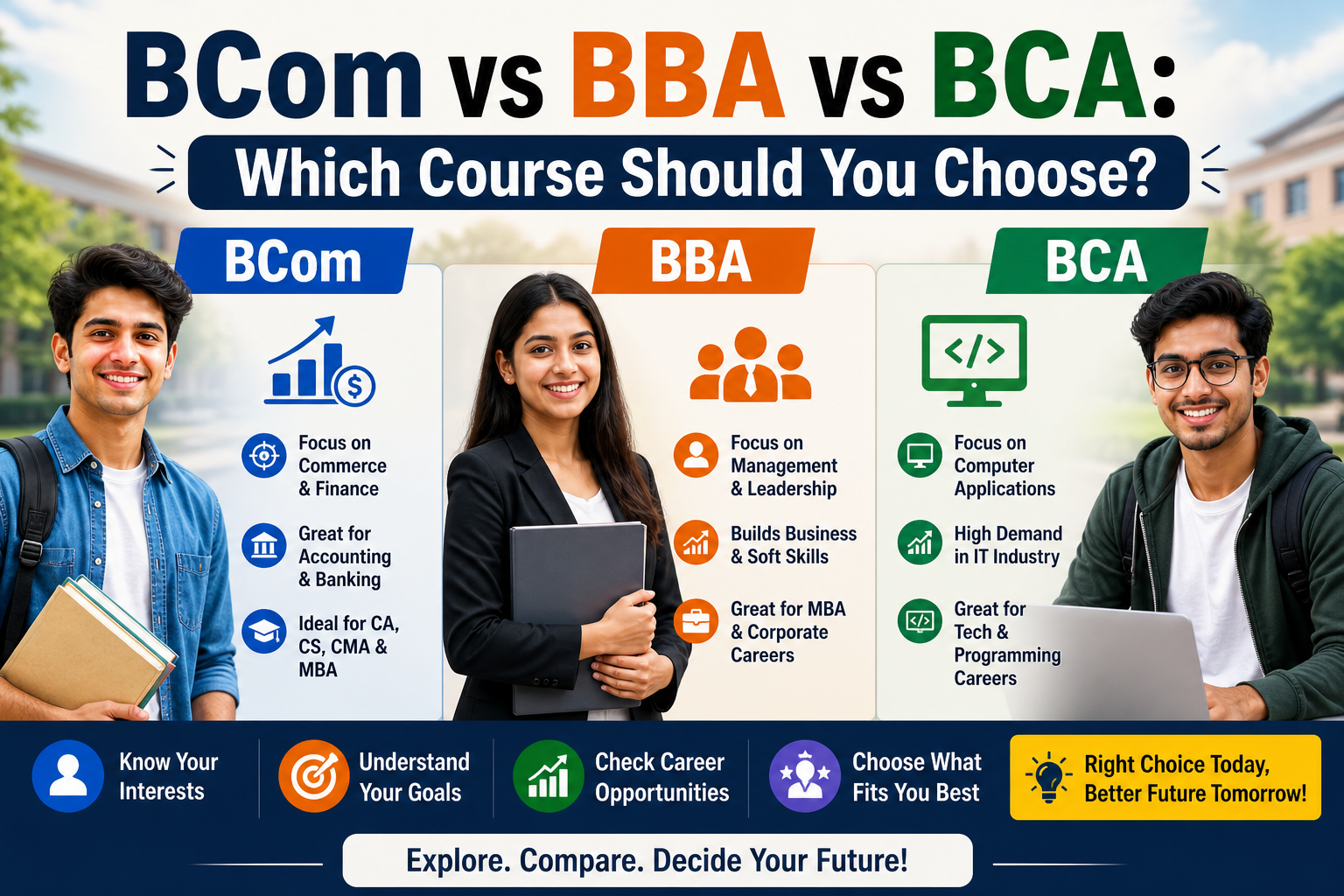
BCom vs BBA vs BCA: Which Course Should You Choose?
“Everyone is suggesting something different… what should I actually choose?”
After Class 12, this confusion is completely normal. Parents may suggest BCom for stability, friends may go for BBA, and others may push you toward BCA because “IT has scope.”
But here’s the problem:
Choosing the wrong course can cost you 3 years and delay your career growth.
This guide will give you a clear, honest, and practical comparison of BCom vs BBA vs BCA—so you can make the right decision based on your strengths and future goals.
Quick Comparison Summary
|
Factor |
BCom |
BBA |
BCA |
|
Field |
Commerce |
Business Management |
IT / Computer |
|
Duration |
3 years |
3 years |
3 years |
|
Focus |
Accounting, Finance |
Management, Business |
Software, IT |
|
Coding |
No |
No |
Yes (basic–moderate) |
|
Best For |
Finance careers |
Management roles |
Tech careers |
|
Avg Salary |
₹2–6 LPA |
₹3–8 LPA |
₹2.5–7 LPA |
|
Future Scope |
Stable |
High growth |
High (skill-based) |
Quick Answer: Which Course is Best After 12th?
There is no “one best” course.
- Choose BCom if you like finance and accounts
- Choose BBA if you want business/management
- Choose BCA if you are interested in technology
What is BCom?
Simple Explanation:
BCom (Bachelor of Commerce) focuses on finance, accounting, taxation, and business fundamentals.
Core subjects:
- Accounting
- Economics
- Business Law
- Taxation
Best for: Students who want careers in finance, CA, banking, or government exams.
What is BBA?
Simple Explanation:
BBA (Bachelor of Business Administration) focuses on management, marketing, and business operations.
Core subjects:
- Marketing
- Human Resource
- Business Strategy
- Entrepreneurship
Best for: Students who want leadership roles, MBA, or business careers.
What is BCA?
Simple Explanation:
BCA (Bachelor of Computer Applications) focuses on computer science, IT, and software basics.
Core subjects:
- Programming
- Database
- Web development
- Networking
Best for: Students interested in IT, software, or tech-related careers.
Detailed Comparison
1. Subjects & Curriculum
- BCom: Theoretical + numerical (accounts-heavy)
- BBA: Practical + case studies (business-focused)
- BCA: Technical + practical (coding + systems)
2. Skills Required
- BCom: Analytical thinking, numerical ability
- BBA: Communication, leadership, decision-making
- BCA: Logical thinking, problem-solving, tech skills
3. Career Opportunities
- BCom: Accountant, Banker, CA, Govt Jobs
- BBA: Manager, HR, Marketing Executive
- BCA: Developer, IT Support, Analyst
4. Salary Expectations (India)
Quick Answer: Salary depends more on skills than degree.
|
Course |
Fresher Salary |
Growth Potential |
|
BCom |
₹2–4 LPA |
Medium |
|
BBA |
₹3–5 LPA |
High |
|
BCA |
₹2.5–5 LPA |
High |
5. Difficulty Level
- BCom: Moderate (theory + calculations)
- BBA: Moderate (concept + communication)
- BCA: Moderate to high (technical learning)
6. Future Scope
- BCom: Stable but competitive
- BBA: Growing with business demand
- BCA: High demand but skill-dependent
Pros and Cons
BCom
Pros:
- Strong foundation in finance
- Good for CA/MBA
- Stable career paths
Cons:
- Limited growth without higher studies
- Competitive field
BBA
Pros:
- Broad career options
- Strong for MBA
- Leadership skills
Cons:
- Requires MBA for high growth
- Competitive placements
BCA
Pros:
- High demand in IT
- Multiple career paths (coding + non-coding)
- Future-ready field
Cons:
- Requires continuous skill upgrade
- Competitive job market
Best Course Based on Student Type
Analytical students: BCom
Business-minded students: BBA
Tech-oriented students: BCA
Non-coding preference: BCom / BBA
Coding interest: BCA
Career Paths After Each Course
After BCom:
- Chartered Accountant (CA)
- Banking
- Finance roles
After BBA:
- MBA → Manager roles
- Marketing / HR
- Entrepreneurship
After BCA:
- Software Developer
- Data Analyst
- Digital Marketing
- IT Support
Reality Check: Myths vs Facts
Myth: BCA has no scope
Fact: It has strong scope—but only with skills
Myth: BCom guarantees a stable job
Fact: Competition is high without specialization
Myth: BBA is easy
Fact: Requires strong communication and leadership
How to Choose the Right Course (Step-by-Step)
- Identify your interest:
- Finance → BCom
- Business → BBA
- Technology → BCA
- Check your strengths:
- Numbers → BCom
- Communication → BBA
- Logic → BCA
- Think long-term:
- CA/MBA → BCom
- MBA/Business → BBA
- IT career → BCA
- Research job market trends
Common Mistakes Students Make
- Choosing based on friends
- Following trends blindly
- Ignoring personal interest
- Not researching career scope
- Thinking degree alone is enough
What Recruiters Look For
- Practical skills
- Communication
- Problem-solving
- Internship experience
FAQ Section
1. Which is better: BCom, BBA, or BCA?
It depends on your interest—finance (BCom), business (BBA), or IT (BCA).
2. Which course has the highest salary?
BCA and BBA can offer higher salaries with skills and experience.
3. Is BCA better than BBA?
Only if you are interested in technology.
4. Can I switch careers after choosing one?
Yes, but it requires extra effort and skill-building.
5. Which course is best after 12th commerce?
BCom and BBA are traditional options, but BCA is also possible.
6. Is MBA necessary after BBA or BCom?
Not mandatory, but highly recommended for growth.
Conclusion
Choosing between BCom vs BBA vs BCA is not about which course is “best”—it’s about which course is best for YOU.
Each course offers strong opportunities, but success depends on:
- Your interest
- Your skills
- Your effort
At UBM College, students are guided through the right career path with practical learning, mentorship, and industry-focused training across BCom, BBA, and BCA programs.
If you want clarity, confidence, and a strong career foundation:
Take the first step with the right guidance. Choose UBM College