B.Com vs B.Com Honours: Subjects, Career Scope & Higher Studies
B.Com vs B.Com Honours: What Is the Difference?
Students interested in commerce after Class 12 often come across two degree options: B.Com and B.Com Honours.
Both programmes are undergraduate commerce degrees and can introduce students to subjects such as accounting, finance, economics, taxation, business law and management. However, their academic structure and level of specialization may differ depending on the university and curriculum.
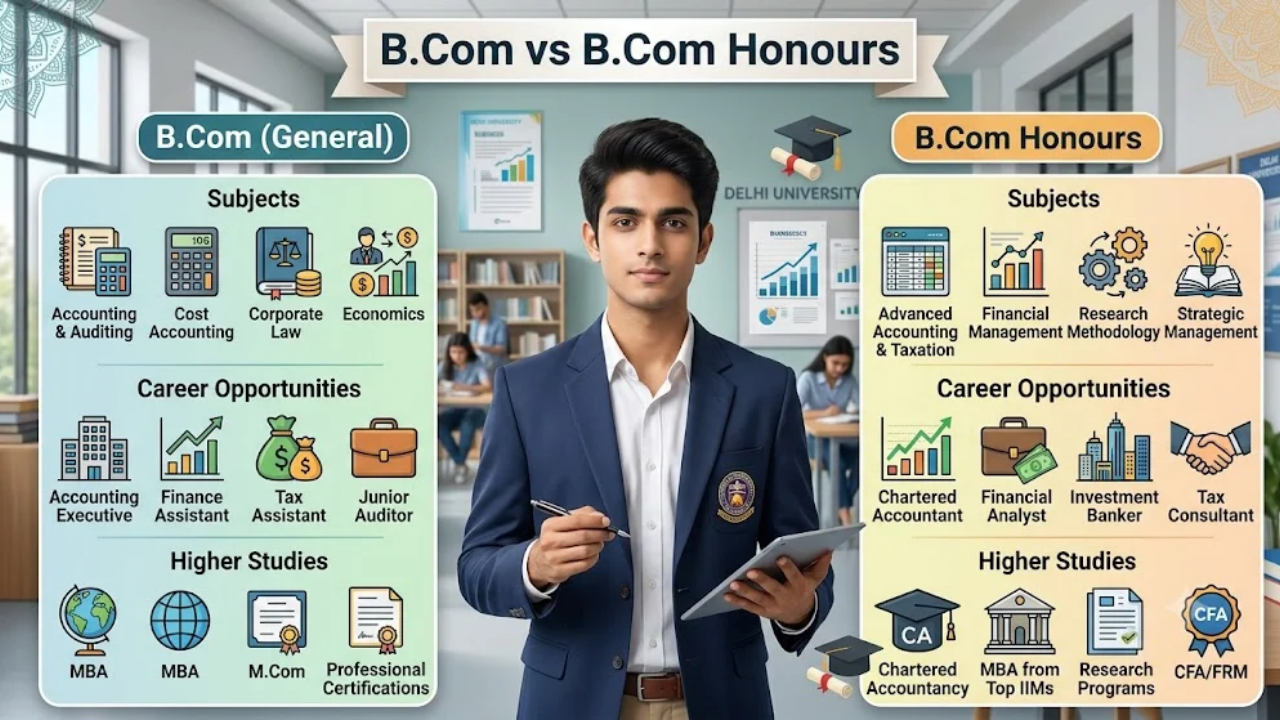
A B.Com programme generally provides broad exposure to different areas of commerce, while B.Com Honours may provide greater depth or specialization in particular commerce subjects.
What Is B.Com?
Bachelor of Commerce (B.Com) is an undergraduate degree focused on commerce, business, accounting, finance and related areas.
Depending on the institution and curriculum, students may study subjects such as:
- Financial Accounting
- Business Economics
- Business Law
- Corporate Accounting
- Cost Accounting
- Taxation
- Financial Management
- Business Communication
- Auditing
- Management
- Entrepreneurship
- Business Mathematics or Statistics
A B.Com programme can provide students with a broad understanding of how businesses, financial systems and commercial activities operate. The exact subjects and programme structure vary between universities and colleges.
What Is B.Com Honours?
B.Com Honours is also an undergraduate commerce degree, but the programme may provide greater academic depth in commerce and related subjects.
Depending on the university, students may receive more focused exposure to areas such as:
- Accounting
- Finance
- Economics
- Taxation
- Business Law
- Auditing
- Financial Management
- Corporate Accounting
- Business Statistics
- Management
Some programmes may also provide elective or specialization options.
However, students should not assume that every B.Com Honours programme follows the same curriculum. The meaning and structure of an "Honours" programme can vary depending on the university and applicable academic framework.
Students should therefore review the actual syllabus before choosing between B.Com and B.Com Honours.
B.Com vs B.Com Honours: Key Differences
The main differences can be understood through the academic focus and curriculum of the programmes.
|
Factor |
B.Com |
B.Com Honours |
|
Degree Type |
Undergraduate commerce degree |
Undergraduate commerce degree with greater subject focus/depth depending on curriculum |
|
Academic Focus |
Broad commerce education |
More focused or in-depth commerce education |
|
Subjects |
Accounting, finance, economics, taxation, business and management |
Similar core areas, potentially with greater depth or specialization |
|
Specialization |
Depends on institution |
May provide greater scope for focused/elective study |
|
Career Options |
Commerce, accounting, banking, finance, business and related fields |
Commerce, accounting, banking, finance, business and related fields |
|
Higher Studies |
M.Com, MBA and other eligible programmes |
M.Com, MBA and other eligible programmes |
|
Best Suited For |
Students seeking broad commerce exposure |
Students interested in deeper commerce study |
These are general differences. The actual structure depends on the university, college and curriculum.
B.Com vs B.Com Honours Subjects
Students sometimes assume that the two programmes contain completely different subjects.
In reality, there can be significant overlap.
Both programmes may cover fundamental areas such as:
- Accounting
- Finance
- Economics
- Taxation
- Business Law
- Management
- Auditing
- Business Communication
The difference may lie in the depth, number of papers, electives or specialization opportunities offered within the curriculum.
Common B.Com Subjects
Depending on the programme, B.Com students may study:
Financial Accounting
Students learn fundamental concepts related to recording, organising and understanding financial transactions.
Business Economics
Business Economics introduces economic principles and how they relate to business decisions.
Business Law
Students may study legal principles relevant to businesses and commercial activities.
Cost Accounting
Cost Accounting focuses on understanding and analysing costs within organisations.
Taxation
Students can develop a foundation in taxation concepts and their application.
Financial Management
This area introduces concepts related to financial planning, investment and business financial decisions.
Auditing
Auditing introduces students to the examination and verification of financial information and processes.
B.Com Honours Subjects
A B.Com Honours programme may cover many of the same core areas while providing greater academic focus.
Depending on the institution, subjects may include:
- Advanced Financial Accounting
- Corporate Accounting
- Cost and Management Accounting
- Financial Management
- Business Economics
- Corporate Law
- Direct and Indirect Taxation
- Auditing
- Business Statistics
- Investment Management
- Banking and Financial Services
- Entrepreneurship
Again, these are examples rather than a universal B.Com Honours syllabus.
Students should always check the curriculum of the specific institution they are considering.
Which Course Has More Specialization?
B.Com Honours is generally associated with a more focused academic approach.
Depending on the programme, students may have opportunities to develop deeper knowledge in areas such as:
- Accounting
- Finance
- Taxation
- Economics
- Banking
- Financial Management
A general B.Com programme may instead provide broader exposure across several areas of commerce.
However, modern course structures can vary significantly. Some general B.Com programmes may also provide electives or specialization opportunities. Therefore, students should compare the actual subjects and electives, rather than choosing solely based on the programme name.
Skills You Can Develop Through B.Com and B.Com Honours
Both programmes can help students develop skills relevant to commerce and business careers.
Accounting Skills
Students can learn how financial information is recorded, organised and interpreted.
Analytical Skills
Commerce involves evaluating financial, economic and business information.
Developing analytical thinking can help students understand problems and make informed decisions.
Numerical Skills
Accounting, finance, taxation and statistics may require students to work with numbers and quantitative information.
Communication Skills
Business communication can be useful for:
- Interviews
- Presentations
- Client interactions
- Teamwork
- Professional correspondence
Research Skills
Students may need to research companies, industries, financial information and economic developments as part of academic work.
Digital Skills
Modern commerce students can benefit from developing familiarity with:
- Spreadsheets
- Accounting software
- Data analysis
- Presentation tools
- Digital financial systems
Career Scope After B.Com
B.Com graduates can explore entry-level opportunities across several sectors.
Possible career areas include:
- Accounting
- Finance
- Banking
- Insurance
- Taxation
- Auditing
- Sales
- Marketing
- Business Development
- Operations
- Financial Services
Potential entry-level roles may include:
- Accounts Executive
- Finance Executive
- Banking Executive
- Audit Associate
- Tax Assistant
- Business Development Executive
- Operations Executive
- Sales Executive
Career opportunities depend on the graduate's skills, qualifications, internships, experience and employer requirements.
Career Scope After B.Com Honours
B.Com Honours graduates can explore many of the same industries as B.Com graduates.
Potential career areas include:
- Accounting
- Corporate Finance
- Banking
- Financial Services
- Taxation
- Auditing
- Investment-related services
- Business Analysis
- Consulting
- Operations
Possible entry-level positions may include:
- Accounts Executive
- Finance Associate
- Audit Associate
- Tax Executive
- Banking Associate
- Financial Services Executive
- Business Analyst Trainee
- Management Trainee
Some specialized roles may require additional professional qualifications or technical skills.
B.Com vs B.Com Honours: Career Scope
Students should be careful about assuming that the degree title alone determines career success.
Both programmes can provide access to commerce-related career pathways.
Employers may consider several factors, including:
- Academic background
- Practical skills
- Internships
- Communication ability
- Technical skills
- Professional qualifications
- Work experience
- Job-specific knowledge
A B.Com Honours degree may provide deeper academic exposure in certain areas, but this does not mean that every B.Com Honours graduate will automatically have better career outcomes than every B.Com graduate.
Career development depends on how students build upon their degree.
B.Com vs B.Com Honours for Accounting Careers
Students interested in accounting should compare how much accounting-related coursework each programme provides.
Relevant subjects can include:
- Financial Accounting
- Corporate Accounting
- Cost Accounting
- Management Accounting
- Auditing
- Taxation
Students can also develop practical skills in:
- Excel
- Accounting software
- Financial statements
- Data analysis
For specialized accounting careers, additional professional qualifications may also be required or beneficial depending on the intended role.
B.Com vs B.Com Honours for Banking Careers
Both B.Com and B.Com Honours graduates can explore banking-related opportunities, depending on the eligibility requirements of the particular job or examination.
Commerce education can provide useful exposure to:
- Accounting
- Economics
- Finance
- Banking
- Business
- Financial management
Students interested in banking can also develop:
- Quantitative aptitude
- Reasoning
- Communication
- Financial awareness
- Computer skills
For competitive banking examinations, students should check the latest official eligibility requirements and examination notifications.
B.Com vs B.Com Honours for Finance Careers
Students interested in finance should pay particular attention to the curriculum.
Useful subjects may include:
- Financial Management
- Corporate Finance
- Investment Management
- Financial Accounting
- Economics
- Statistics
- Financial Markets
A programme offering deeper exposure to these areas may be useful for students who already know they want to pursue finance.
However, additional skills and qualifications can become important for specialized financial careers.
Higher Studies After B.Com
Completing B.Com does not mean students have to enter the workforce immediately.
Several higher-study pathways may be available.
M.Com
A Master of Commerce (M.Com) can provide advanced study in commerce and related areas.
Students interested in deeper academic knowledge may consider this pathway.
MBA
B.Com graduates can also consider an MBA if they are interested in areas such as:
- Finance
- Marketing
- Human Resources
- Operations
- Business Analytics
- Management
Admission requirements vary by institution.
Professional Qualifications
Students may explore professional qualifications related to:
- Accounting
- Finance
- Taxation
- Banking
- Investments
The eligibility, duration and examination requirements vary by qualification.
Competitive Examinations
Graduates may also prepare for government, banking and other competitive examinations for which they meet the required eligibility criteria.
Higher Studies After B.Com Honours
B.Com Honours graduates can explore similar higher-study pathways.
Possible options include:
- M.Com
- MBA
- Professional accounting qualifications
- Finance-related programmes
- Banking and financial certifications
- Management programmes
- Other postgraduate courses
Students interested in research or academic careers can also investigate relevant postgraduate and research pathways.
The appropriate choice depends on long-term career goals.
B.Com vs B.Com Honours for MBA
Both B.Com and B.Com Honours graduates can consider MBA programmes, subject to the eligibility requirements of the institution.
Students interested in an MBA may choose specializations such as:
- Finance
- Marketing
- Human Resources
- Operations
- Business Analytics
- International Business
For MBA admission, institutions may consider factors beyond the undergraduate degree title, including entrance examinations, academic performance, interviews and other admission requirements.
Students should check the current criteria of the MBA programmes they are considering.
B.Com vs B.Com Honours for M.Com
Students interested in advanced commerce studies may consider an M.Com after either programme, subject to institutional eligibility requirements.
M.Com can provide deeper exposure to areas such as:
- Accounting
- Finance
- Economics
- Taxation
- Business
- Research
Students considering academic or research-oriented pathways should examine the postgraduate curriculum and any additional qualifications required for their intended career.
Can You Pursue Professional Courses After B.Com or B.Com Honours?
Depending on eligibility, students from both programmes can explore professional qualifications in areas such as:
- Chartered Accountancy
- Company Secretary
- Cost and Management Accounting
- Finance
- Investment
- Banking
- Taxation
Each professional programme has its own registration, examination and eligibility requirements.
Students should refer to the relevant professional body's current official information before making a decision.
B.Com vs B.Com Honours: Which Is Better for You?
Instead of asking which degree is universally "better," students can consider which programme aligns more closely with their academic and career goals.
B.Com May Suit Students Who:
- Want broad exposure to commerce subjects
- Are still exploring different commerce careers
- Want flexibility across business areas
- Plan to develop additional skills alongside their degree
B.Com Honours May Suit Students Who:
- Want deeper study of commerce
- Have a stronger interest in accounting or finance-related subjects
- Prefer a more focused academic curriculum
- Are considering advanced commerce studies
These are general considerations rather than strict rules.
The curriculum should be one of the most important factors in the final decision.
How to Choose Between B.Com and B.Com Honours
Before choosing either programme, consider the following factors.
1. Compare the Subjects
Look at the semester-wise curriculum for both programmes.
Do not decide based only on the course title.
2. Identify Your Career Interests
Think about whether you are interested in:
- Accounting
- Finance
- Banking
- Taxation
- Business
- Management
- Entrepreneurship
Your interests can help you determine which curriculum fits your goals.
3. Consider Higher Studies
If you already plan to pursue M.Com, MBA or a professional qualification, research its eligibility requirements.
4. Look at Practical Learning
Check whether the programme provides opportunities for:
- Projects
- Internships
- Presentations
- Workshops
- Industry exposure
5. Consider Skill Development
A degree is one part of career preparation.
Students should also think about the practical skills they can develop during college.
Skills to Learn During B.Com or B.Com Honours
Regardless of which programme you choose, additional skills can strengthen your professional profile.
Useful skills may include:
Excel
Spreadsheet skills are useful across accounting, finance, operations and business roles.
Accounting Software
Students interested in accounting can learn commonly used accounting and financial software.
Data Analysis
Basic data analysis can complement finance, business and research-related careers.
Communication
Strong communication can be useful in interviews, presentations and professional environments.
Financial Literacy
Understanding financial statements, budgeting and financial concepts can support several commerce careers.
Digital Skills
As businesses adopt digital systems, familiarity with technology and online business tools can become increasingly useful.
How to Build Your Career During College
Students do not necessarily have to wait until graduation to begin preparing for their careers.
1. Take Internships
Look for internships related to accounting, finance, banking, marketing, operations or other areas that interest you.
2. Build Practical Projects
Projects can demonstrate how you apply academic knowledge.
Examples include:
- Financial statement analysis
- Business plans
- Market research
- Budget analysis
- Company performance analysis
3. Learn a Complementary Skill
Combine your commerce knowledge with another skill.
For example:
- Commerce + Excel → Accounting and Finance
- Commerce + Data Analysis → Business Analysis
- Commerce + Digital Marketing → Marketing
- Commerce + Financial Modelling → Finance
4. Research Job Requirements
Read actual job descriptions for roles you may want after graduation.
Look at the qualifications, skills and experience employers commonly request.
5. Explore Higher Studies Early
If you plan to pursue a professional qualification or postgraduate programme, research its requirements while you are still completing your undergraduate degree.
Future Scope of B.Com and B.Com Honours
Commerce graduates can work across industries because organisations continue to require professionals in accounting, finance, banking, operations, marketing and business management.
However, these professions are also changing.
Students entering the commerce field increasingly encounter:
- Digital accounting systems
- Online banking
- Financial technology
- Data analytics
- Automation
- Cloud-based business applications
- AI-assisted tools
This means students can benefit from combining traditional commerce knowledge with digital and analytical skills.
Rather than depending on the degree title alone, students can prepare for the future by developing a combination of:
Commerce Knowledge + Practical Skills + Digital Literacy + Experience
Both B.Com and B.Com Honours can provide an academic foundation for this development.
Frequently Asked Questions
1. What is the main difference between B.Com and B.Com Honours?
B.Com generally provides broad exposure to commerce subjects, while B.Com Honours may offer greater depth or specialization in commerce. The exact difference depends on the university and curriculum.
2. Is B.Com Honours better than B.Com?
Neither programme is universally better. B.Com may suit students seeking broader commerce exposure, while B.Com Honours may appeal to students who prefer more focused study. Students should compare the actual curricula and their career goals.
3. Are B.Com and B.Com Honours subjects the same?
There can be significant overlap. Both may include accounting, finance, economics, taxation, business law and management. B.Com Honours may provide greater depth or additional focused papers depending on the institution.
4. Which is better for accounting: B.Com or B.Com Honours?
Students interested in accounting should compare the accounting, auditing, taxation and finance papers offered by each programme. A curriculum with greater accounting depth may better align with their interests, but additional qualifications can also matter for specialised careers.
5. Can I do an MBA after B.Com?
Yes. B.Com graduates can consider MBA programmes if they meet the eligibility and admission requirements of the institution.
6. Can I do an MBA after B.Com Honours?
Yes. B.Com Honours graduates can also pursue MBA programmes subject to the relevant admission requirements.
7. Can B.Com and B.Com Honours graduates apply for banking jobs?
Both can explore banking opportunities where they meet the required eligibility criteria. Requirements vary by employer, position and competitive examination.
8. Which has more career scope: B.Com or B.Com Honours?
Both degrees can lead to careers in accounting, finance, banking, taxation, business and related fields. Career outcomes depend on factors such as skills, experience, additional qualifications and the requirements of individual employers.
9. Can I pursue professional courses after B.Com or B.Com Honours?
Depending on eligibility, graduates may explore professional programmes in accounting, company law, cost and management accounting, finance, banking and related areas. Students should check the current requirements of the relevant professional body.
10. How should I choose between B.Com and B.Com Honours?
Compare the curriculum, subjects, electives, practical learning opportunities and higher-study pathways of each programme. Then consider which option better matches your interests and long-term academic or career goals.
Conclusion
The difference between B.Com and B.Com Honours primarily relates to the academic structure and depth of study offered by a particular programme.
A B.Com programme generally provides broad exposure to accounting, finance, economics, taxation, business and management, while B.Com Honours may provide greater academic focus or specialization within commerce..
The more useful approach is to compare the actual syllabus, subjects, electives, practical learning opportunities, higher-study eligibility and career relevance of the programmes available to you.
Both B.Com and B.Com Honours can provide pathways toward accounting, finance, banking, taxation, business, management and higher education. Career outcomes will also depend on the skills, internships, qualifications and experience students develop alongside their degree.
Explore the commerce and undergraduate programmes available at UBM College and understand the curriculum, academic opportunities and career pathways before planning your next step.